

Do I have to be put to sleep to have my wisdom tooth removed?
The short answer is no. Most people have their wisdom teeth taken out comfortably while awake, with the area fully numbed. Being “put to sleep” (a general anaesthetic) is only needed in specific situations. We’ll help you choose the option that keeps you comfortable and safe.
What “being put to sleep” actually means
- Local anaesthetic (numbing injections)
- What it is: Small injections to numb the gums and tooth.
- How it feels: You’ll feel pressure, pushing, and vibration, but no sharp pain.
- Good for: Most wisdom tooth removals, especially when the tooth is fairly straightforward.
- After: Numbness wears off in a few hours; you can usually get on with light activities the same day.
- Oral sedation (a calming tablet)
- What it is: A prescription tablet taken before your appointment to reduce anxiety.
- How it feels: You’re awake but relaxed and less aware of time. We still numb the tooth locally.
- Good for: Nervous patients or anyone who’d like a calmer experience.
- After: You’ll need someone to take you home and stay with you; no driving or important decisions for 24 hours.
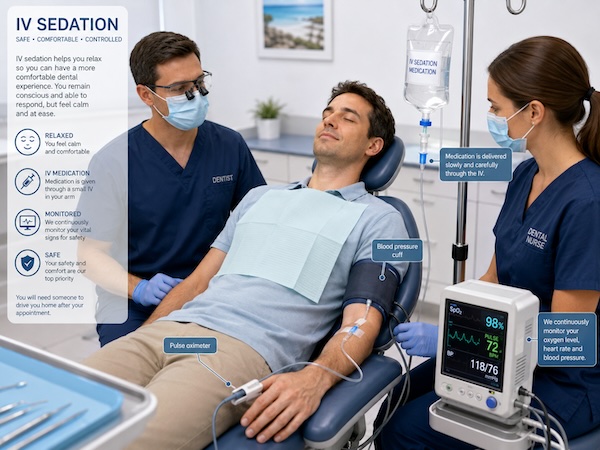
- IV sedation (drip sedation)
- What it is: A sedative given through a small cannula in your arm. You’re deeply relaxed and drowsy, but breathing on your own.
- How it feels: Many patients remember little or nothing of the procedure. We still use local anaesthetic so you don’t feel pain.
- Good for: Strong dental anxiety, complex extractions, or removing several wisdom teeth at once.
- After: Escort required; rest for the day; no driving or signing documents for 24 hours.
- General anaesthetic (fully asleep)
- What it is: A hospital-based procedure with an anaesthetist where you’re completely unconscious.
- How it feels: You won’t be aware of the procedure at all.
- Good for: Very complex cases or situations where treatment isn’t possible under sedation.
- After: Hospital recovery processes apply; usually more downtime and higher cost. Used only when clearly beneficial.
How we decide what’s right for you
- Your X-rays and scan: We look at tooth position, root shape, and how close the tooth is to nearby nerves and sinuses.
- Your comfort and preferences: Your previous dental experiences, anxiety level, and pain threshold matter.
- Your health: Medical history, medications, and any conditions that affect sedation choices.
- Practicalities: Whether we’re removing one tooth or multiple teeth in the same visit, and how complex the surgery is likely to be.
When local anaesthetic alone is usually enough
- The tooth is erupted (visible) or partially erupted with good access.
- X-rays show simple root shapes and clear space around the tooth.
- You feel reasonably calm about treatment.
- We’re removing one or two teeth with straightforward technique.
When we might recommend sedation
- You feel very anxious or have had difficult dental experiences before.
- The tooth is impacted (stuck under gum or bone) or has curved/complex roots.
- The lower wisdom tooth lies close to the main nerve in the jaw (we’ll show you this on your scan).
- We’re removing several wisdom teeth in one visit.
- You have a strong gag reflex or find it hard to keep your mouth open comfortably.
What you’ll feel during treatment
- Sounds and pressure are normal: You may hear instruments and feel gentle pushing or rocking. That’s expected and not a sign of pain.
- Sharp pain is not expected: If you feel anything sharp, tell us and we’ll add more anaesthetic.
- You can take breaks: Hand signals are agreed before we start so you can pause at any time.
- With sedation: You’ll feel calm and time often seems to pass quickly; many patients don’t remember much afterwards.
After your wisdom tooth removal: what to expect
- Numbness: Lasts a few hours. Avoid hot drinks and chewing your cheek or lip while numb.
- Bleeding: Minor oozing for the first day is normal. We’ll give you a gauze pack and show you how to bite down to stop it.
- Swelling and stiffness: Usually peak at 48–72 hours, then settle over a few days. Ice packs (10 minutes on, 10 minutes off) help on day one.
- Discomfort: Most people manage well with paracetamol and ibuprofen taken together (if suitable for you). We’ll tailor pain relief to your medical history.
- Eating and drinking: Cool, soft foods at first—yoghurt, soup (not hot), scrambled eggs, mashed potato. Drink plenty of water.
- Mouth care: Starting 24 hours after surgery, rinse gently with warm salt water after meals. Brush as normal, but avoid the socket area at first.
- Activity: Take it easy for 24–48 hours. Avoid strenuous exercise, smoking, alcohol, and drinking through straws for a few days to protect healing.
- Stitches: If placed, they’re often dissolvable and will come out on their own; we’ll let you know if you need a review visit.
Common questions
- Will it hurt?
- During: You should not feel sharp pain. We’ll keep you comfortable and top up anaesthetic if needed.
- After: Some soreness and swelling are normal for a few days. We’ll give you a simple, effective pain plan.
- How long does it take?
- Simple cases can take 20–40 minutes per tooth; complex impactions may take longer. Your consultation will give a personalised estimate.
- Can I go back to work the next day?
- Many people do after a simple removal under local anaesthetic. If bone needs to be removed or several teeth are taken out, you may prefer 2–3 days off.
- What are the risks?
- All procedures carry some risk, such as dry socket (delayed healing), infection, or temporary numbness, especially with lower wisdom teeth near the nerve. We’ll explain your individual risk based on your scan and how we minimise it.
- Is general anaesthetic safer?
- Not necessarily. For most patients, local anaesthetic with or without sedation is the safest, simplest option with the quickest recovery. General anaesthetic has its place, but it also carries higher cost and additional medical risks, which is why we reserve it for select cases.
Your personalised plan
- Thorough assessment: We take a detailed medical history and highdefinition imaging.
- Clear choices: We explain your options in plain language and agree the approach with you.
- Comfort-first care: Whether you choose local anaesthetic, oral sedation, or IV sedation, your safety and comfort are continuously monitored.
A logical next step is to book a consultation for an examination and Xrays. We’ll confirm how complex your case is, talk through your preferences, and tailor the anaesthesia plan so you feel confident and comfortable.
Opening Hours
Monday – 9.00am – 5.00pm
Tuesday – 9.00am – 8.00pm
Wednesday – 9.00am – 5.00pm
Thursday – 9.00am – 8.00pm
Friday – 9.00am – 5.00pm
Saturday – 9.00am – 1.00pm
Sunday – Closed
Use our menu and search function to find what you are looking for