

Can a Loose Adult Tooth Tighten Back Up? (What You Need to Do Right Now)
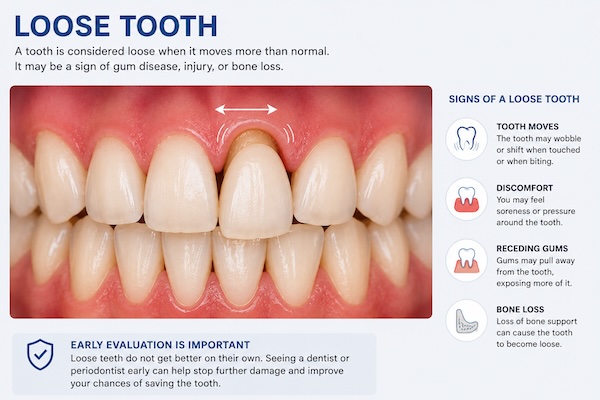
Feeling a permanent tooth wobble is an instant jolt of panic. Your mind immediately jumps to the worst-case scenario: “Am I about to lose my tooth?”
Here is the quick, reassuring truth: Yes, a loose tooth can often tighten back up.
However, it won’t happen by magic. In adults, a loose tooth is a flashing red warning light that something is wrong underneath the surface—usually gum disease. The good news? Modern dental care is incredibly effective. If you catch it early, you can stabilize your tooth and save your smile.
Here is exactly what is happening under your gums, and how to fix it.
The “Suspension System” Holding Your Teeth in Place
Your teeth aren’t just superglued into your jawbone. They are held in place by a remarkably sophisticated shock-absorption system made of three parts:
- The Gums: The protective seal around the base of your tooth.
- The Jawbone: The solid foundation.
- The Periodontal Ligament: Millions of tiny, elastic-like fibers that anchor your tooth to the bone.
When this support system gets damaged, the tooth begins to rock. While gum disease is the number one culprit, teeth can also loosen due to night-time grinding (bruxism), physical trauma, bite misalignment, smoking, or uncontrolled diabetes.
How Gum Disease Stages a Takeover
Everything starts with plaque—that sticky, bacteria-filled film that forms on your teeth every day. If it isn’t thoroughly cleaned away, it triggers a chain reaction.
The Warning Signs: Gingivitis vs. Periodontitis
Feature | Gingivitis (Early Stage) | Periodontitis (Advanced Stage) |
What’s happening | Gums are irritated by surface plaque. | Bacteria dive deep, attacking bone and ligaments. |
The Symptoms | Bleeding when brushing, redness, puffy gums, bad breath. | Teeth drifting or loosening, gaps forming, painful chewing. |
Is it reversible? | 100% Yes. Good hygiene bounces things back. | No, but it can be stopped and stabilized. |
⚠️ The Tipping Point: Once gum disease reaches the periodontitis stage, the bacteria actively dissolve the bone holding your teeth in place. This is usually the exact moment people notice a wobble and realize something is seriously wrong.
The Big Question: Can It Actually Tighten Again?
In many cases, yes. If you stop the infection and clear out the bacteria, the intense inflammation will subside. As your gums heal, they tighten back around the tooth like a freshly washed sleeve, drastically reducing the wobble.
However, we have to be realistic:
- Lost bone does not easily grow back.
- If a tooth has lost more than half of its bone support, saving it becomes a much steeper uphill battle.
- Timing is everything. The sooner you get professional help, the higher your chances of keeping your natural tooth.
How a Periodontist Saves a Loose Tooth
A periodontist is a specialist who focuses entirely on the foundational structures of your mouth. Think of them as the structural engineers of your smile.
When you see a specialist, they won’t just look at the tooth—they will map your bone levels, measure the “pockets” where bacteria hide, and check your bite. From there, they deploy targeted treatments to anchor that tooth back down:
- Deep Cleaning (Root Surface Debridement): This goes way beyond a standard dental clean. The hygienist or periodontist numbs the area and scrapes away the hardened tartar hiding deep beneath the gum line, allowing the tissue to finally reattach to the tooth.
- Splinting: If a tooth is too loose to heal on its own, a periodontist can temporarily anchor it to its stronger neighbors using a discreet wire or resin. This holds it rock-solid so the surrounding tissues can heal without being disturbed by chewing.
- Bite Adjustment: If you are clenching or grinding your teeth, you are essentially hammering an already weakened structure. Evening out your bite or fabricating a custom night guard relieves this destructive pressure.
- Periodontal Surgery: For advanced cases, minor surgery allows direct access to clean deep pockets and even introduce bone grafts to regenerate lost support.
Will a Loose Adult Tooth Fix Itself?
To be completely candid: No.
Unlike a bruised muscle, a loose adult tooth will not heal with just “rest” or time. Ignoring a loose tooth allows bacteria to continue eating away at the jawbone. Eventually, the tooth won’t just be loose—it will fall out or require extraction.
The Checklist: When to Book an Appointment
If you notice any of these red flags alongside a wiggly tooth, don’t wait for your next six-month check-up:
- Gums that bleed every time you brush or floss
- Chronic bad breath that mouthwash can’t fix
- Gums that look like they are pulling away or shrinking from your teeth
- Pus or discharge near the gum line
- A sudden change in how your teeth fit together when you bite
How to Protect Your Smile at Home
While you need a professional to treat a loose tooth, you control the daily defense line. Keep your foundation strong by brushing twice a day, using interdental brushes or floss to clean the hidden gaps, avoiding smoking (which suffocates gum blood flow), and getting regular professional cleanings.
A loose tooth is a serious warning sign—but it isn’t a final sentence for your smile. With quick, expert intervention, you can stabilize the foundation and keep your natural teeth exactly where they belong.
Opening Hours
Monday – 9.00am – 5.00pm
Tuesday – 9.00am – 8.00pm
Wednesday – 9.00am – 5.00pm
Thursday – 9.00am – 8.00pm
Friday – 9.00am – 5.00pm
Saturday – 9.00am – 1.00pm
Sunday – Closed
Use our menu and search function to find what you are looking for