

What Is a White Crown? A Complete Guide to Tooth Crowns
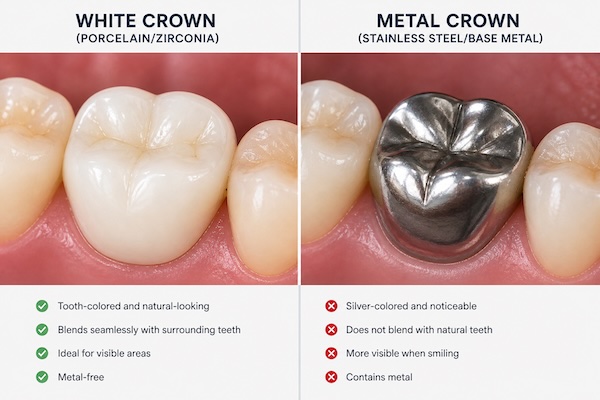
A white crown is a dental crown designed to look like a natural tooth. Unlike traditional metal crowns, white crowns are made from tooth-colored materials, so they blend seamlessly with your smile—often so well that even you might forget which tooth has the crown.
But to fully understand what a white crown is and why it might be the right choice for you, it helps to first know what a dental crown actually does and how the technology has evolved.
What Is a Dental Crown?
A dental crown is a custom-made cap that fits over a damaged, weakened, or cosmetically imperfect tooth. It completely encases the visible portion of the tooth above the gum line, restoring its:
- Shape — returning the tooth to its original contours
- Size — rebuilding structure lost to decay or fracture
- Strength — reinforcing a tooth that can no longer support normal chewing forces
- Appearance — covering discoloration, chips, or irregular shapes
Dentists commonly recommend crowns when a tooth is:
- Severely decayed (too damaged for a filling alone)
- Cracked, broken, or fractured
- Worn down from grinding or acid erosion
- Structurally weakened after a root canal
- Serving as an anchor for a dental bridge
- Covering a dental implant
Think of a crown as a protective helmet for your tooth—one that’s custom-fitted to your bite and designed to last for years, sometimes decades.
A Brief History: From Gold to Tooth-Colored
Dental crowns aren’t new. Ancient civilizations, including the Etruscans and Egyptians, fashioned crowns from gold, ivory, and even animal teeth. Gold remained the gold standard (pun intended) well into the 20th century because of its durability, biocompatibility, and precise fit.
The problem? Gold is conspicuously not tooth-colored.
The development of porcelain crowns in the mid-1900s marked a turning point. Dentists could finally offer restorations that mimicked the translucency and color of natural enamel. Early porcelain crowns were beautiful but brittle—fine for front teeth that don’t bear heavy chewing forces, less ideal for molars.
Modern materials like zirconia and lithium disilicate have changed the game. Today’s white crowns can rival metal in strength while delivering aesthetics that would have seemed impossible a few decades ago.
So, What Makes a Crown “White”?
A white crown refers specifically to crowns made from materials that mimic the natural color of teeth. These are especially popular for:
- Front teeth, where appearance is paramount
- Premolars, which are often visible when you smile or laugh
- Anyone who simply doesn’t want a metallic glint in their mouth
Unlike silver amalgam or gold crowns, white crowns are virtually unnoticeable. In photographs, in conversation, even in direct sunlight—they just look like teeth.
Types of Materials Used for White Crowns
Several materials are used to create white crowns, each with distinct advantages. The “best” choice depends on where the crown will go, how much force it needs to withstand, and how closely you want it to match your natural teeth.
1. All-Ceramic (Porcelain) Crowns
Porcelain crowns remain one of the most popular choices, especially for front teeth.
What makes them special:
Porcelain can be layered and shaded to replicate the subtle gradations of natural enamel—the slight translucency at the edges, the warmer tones near the gum line. A skilled dental ceramist can create a crown that’s virtually indistinguishable from the teeth around it.
Benefits:
- Highly natural appearance with excellent light transmission
- Exceptional color matching
- Biocompatible (no metal allergies to worry about)
- Ideal for front teeth and visible areas
Considerations:
- Slightly more prone to chipping under heavy bite forces
- May not be the first choice for molars in people who grind their teeth
2. Zirconia Crowns
Zirconia (zirconium dioxide) is a crystalline ceramic that’s become a workhorse in modern dentistry. It’s sometimes called “ceramic steel” because of its remarkable strength.
What makes them special:
Zirconia crowns are milled from solid blocks using computer-aided design (CAD/CAM technology), allowing for precise, consistent results. Newer “multilayer” zirconia mimics the gradient of natural teeth—more opaque at the base, more translucent at the biting edge.
Benefits:
- Extremely durable and resistant to fracture
- Suitable for both front and back teeth
- Virtually chip-proof
- No metal, so no dark lines at the gum margin
- Can be made in a single dental visit with same-day milling technology
Considerations:
- Traditional zirconia can appear slightly more opaque than natural enamel (though newer formulations have largely addressed this)
- Exceptionally hard—your dentist will check that it’s not wearing down opposing teeth
3. Lithium Disilicate (e.g., E.max)
This glass-ceramic material has gained popularity for its combination of strength and beauty.
What makes it special:
Lithium disilicate offers the best of both worlds: it’s stronger than traditional porcelain but retains excellent translucency. It’s often the go-to for anterior (front) crowns where aesthetics are critical but some strength is still needed.
Benefits:
- Outstanding aesthetics with natural light transmission
- Stronger than conventional porcelain
- Excellent for veneers, inlays, and thin restorations
- Bonds exceptionally well to tooth structure
Considerations:
- Not as strong as zirconia for heavy-duty molars
- Typically more expensive than composite options
4. Porcelain-Fused-to-Metal (PFM)
These crowns have a metal substructure (often a gold or base-metal alloy) with a porcelain coating baked over the top.
What makes them special:
PFM crowns were the original “white” crown solution, combining metal’s strength with porcelain’s aesthetics. They’ve been used successfully for decades.
Benefits:
- Stronger than pure porcelain
- Natural-looking outer layer
- Long track record of clinical success
- Often more affordable than all-ceramic options
Considerations:
- The metal underneath may show as a grayish line near the gum, especially if gums recede over time
- Less lifelike than all-ceramic crowns because the metal blocks light transmission
- Not suitable for patients with metal allergies
5. Composite Resin Crowns
Made from tooth-colored filling material, these are the most economical option.
Benefits:
- Most affordable
- Can be fabricated quickly, sometimes chairside
- Easy to repair if damaged
Considerations:
- Least durable of the white crown options
- More prone to staining from coffee, tea, and red wine
- May need replacement sooner than ceramic alternatives
The Crown Process: What to Expect
Getting a white crown typically involves two appointments, though same-day options are increasingly available.
First Appointment
- Examination and preparation — Your dentist numbs the area, removes decay, and reshapes the tooth to create room for the crown.
- Impressions — A digital captures the exact shape of your prepared tooth and surrounding teeth.
- Temporary crown — A plastic or acrylic temporary is placed to protect the tooth while your permanent crown is fabricated.
- Shade matching — Your dentist selects a colour that blends with your natural teeth, sometimes using a shade guide or digital imaging.
Second Appointment (usually 1–2 weeks later)
- Temporary removal — The temporary crown comes off.
- Fit check — Your new crown is tried in to verify fit, bite, and color.
- Cementation — Once everything looks right, the crown is permanently bonded in place.
Same-Day Crowns
Many dental offices now offer CEREC or similar CAD/CAM systems that mill crowns from ceramic blocks in about an hour. You walk in with a damaged tooth and leave with a finished crown—no temporary, no second visit.
Which White Crown Is Right for You?
The best type of white crown depends on several factors:
Factor | Best Material Options |
Front tooth (high visibility) | Lithium disilicate, layered porcelain, or multilayer zirconia |
Back molar (heavy chewing) | Zirconia or PFM |
Grinding/clenching habit | Zirconia (with a night guard recommended) |
Maximum aesthetics | Lithium disilicate or hand-layered porcelain |
Budget-conscious | PFM or composite resin |
Metal allergy | Any all-ceramic option (zirconia, porcelain, lithium disilicate) |
Your dentist will evaluate your bite, the condition of the tooth, and your cosmetic goals to recommend the best fit.
How Long Do White Crowns Last?
With proper care, most white crowns last 10 to 15 years, and many last considerably longer. Zirconia and well-maintained porcelain crowns can serve you for 20+ years.
Longevity depends on:
- Oral hygiene — Crowns can’t get cavities, but the tooth underneath can. Brushing, flossing, and regular cleanings are essential.
- Bite forces — Grinding or clenching accelerates wear. A night guard can protect your investment.
- Diet — Chewing ice, hard candy, or using teeth as tools invites fractures.
- Gum health — Receding gums can expose the crown margin, leading to sensitivity or decay at the edge.
Caring for Your White Crown
A crowned tooth needs the same care as a natural tooth—arguably more, since you want to protect both the crown and the tooth beneath it.
- Brush twice daily with fluoride toothpaste
- Floss daily, sliding the floss down and then out (not snapping it, which can dislodge the crown)
- Avoid hard foods that could crack the porcelain (popcorn kernels, ice, hard candies)
- Wear a night guard if you grind your teeth
- See your dentist regularly for checkups and professional cleanings
A white crown is an excellent solution if you want to restore a damaged tooth while maintaining a natural-looking smile. With modern materials like lithium disilicate and zirconia, today’s crowns are stronger, more lifelike, and more versatile than ever before.
Whether you’re repairing a cracked molar, finishing a root canal, or simply replacing an old metal crown that’s been bothering you for years, there’s a white crown option that fits your needs—and your smile.
Opening Hours
Monday – 9.00am – 5.00pm
Tuesday – 9.00am – 8.00pm
Wednesday – 9.00am – 5.00pm
Thursday – 9.00am – 8.00pm
Friday – 9.00am – 5.00pm
Saturday – 9.00am – 1.00pm
Sunday – Closed
Use our menu and search function to find what you are looking for