

How Long Can I Wait to Replace an Extracted Tooth?
If you’ve just had a tooth removed, or you’re facing an extraction soon, one of the first questions most patients ask is: “How long can I wait before I replace it?”
The honest answer is: it depends on your situation — but in many straightforward cases, you don’t have to wait at all. Replacement can often begin on the very same day as the extraction. In this post, we’ll walk through when immediate replacement is possible, why it’s often the best option, and what your alternatives look like if immediate treatment isn’t right for you.
The Short Answer: Sooner Is Usually Better
Your jawbone is a living tissue. It only stays strong and full because the roots of your teeth constantly stimulate it, similar to how muscles are maintained through use. The moment a tooth is removed, that stimulation stops, and the bone begins to shrink — a process called resorption.
This isn’t something that happens over years. Noticeable bone loss can begin within the first few months after extraction, and the bone tends to shrink fastest in that early period. This is exactly why “wait and see” is rarely the ideal approach, and why we always discuss replacement options before a tooth even comes out, not months afterwards.
The Straightforward Case: Same-Day (Immediate) Replacement
Not every extraction is the same, but many are what we’d call “straightforward” — meaning there’s no active infection, enough healthy bone is present, and the surrounding gum tissue is in good condition. In these cases, we can often place a dental implant into the socket immediately after the tooth is removed, all in the same appointment.
This is known as immediate implant placement, and for the right candidate, it offers some real advantages:
Benefits of Immediate Implant Placement
- One surgical visit instead of two. Rather than healing from the extraction, then coming back weeks or months later for a second procedure to place the implant, both steps happen together. Less time in the chair, less time off work, less overall disruption.
- Better preservation of your natural bone and gum shape. Placing an implant into the socket helps support the surrounding bone and gum tissue right from the start, which helps maintain a more natural-looking contour around the eventual replacement tooth.
- A shorter overall treatment timeline. Because you skip a separate healing period before implant placement, you generally reach your finished, permanent tooth sooner than if the two procedures were done months apart.
- Fewer appointments and less recovery time overall. Combining extraction and implant placement means your mouth only goes through one significant healing process, not two.
It’s worth being clear: immediate placement isn’t right for every patient or every tooth. If there’s infection, insufficient bone, or gum disease present, we may recommend allowing the site to heal first, sometimes with a bone graft, before placing an implant. We’ll always assess your individual case with an examination and imaging (like a CT scan) before recommending a specific pathway.
Why Dental Implants Are Usually the Recommended Replacement
Whether placed immediately or after a short healing period, dental implants are generally considered the gold standard for tooth replacement, and for good reasons:
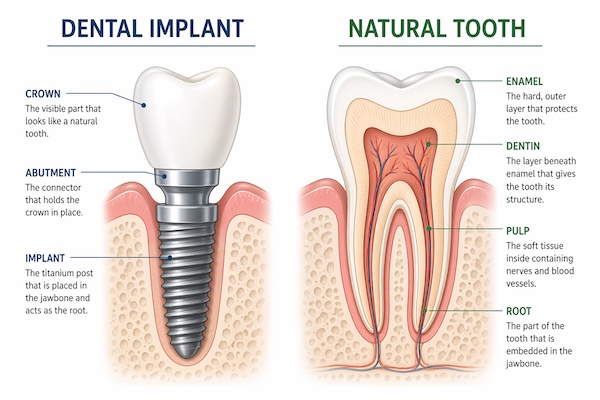
- They preserve your jawbone. An implant is a small titanium post that replaces the root of your tooth, not just the visible crown. Because it sits in the bone and bears chewing forces like a natural root does, it continues to stimulate the bone and helps prevent the shrinkage that occurs with missing teeth.
- They look, feel, and function like natural teeth. A well-made implant crown is custom-shaded and shaped to blend in with your smile, and because it’s anchored in the bone, it feels solid and secure when you eat, speak, or laugh.
- They don’t rely on neighbouring teeth. Unlike a bridge, an implant stands alone. Nothing needs to be shaved down or leaned on for support.
- They’re built to last. With good oral hygiene and regular check-ups, implants have excellent long-term success rates and can last decades.
- They protect your bite and facial structure. Missing teeth can allow neighbouring teeth to drift, shift your bite out of alignment, and even change the shape of your face over time as bone volume is lost. Implants help prevent this domino effect.
What If an Implant Isn’t the Right Fit Straight Away?
Implants aren’t always suitable immediately, and that’s completely normal. If your bone needs time to heal, if you need a bone graft first, or if you’d simply prefer to consider your options, there are two common alternatives worth understanding.
Dental Bridges
A bridge replaces a missing tooth by anchoring a false tooth to the natural teeth on either side of the gap.
Advantages:
- Fixed in place, so there’s no removing it at night
- Faster to complete than an implant in most cases, often in just two or three visits
- A well-established, predictable treatment
Trade-offs:
- The teeth either side of the gap usually need to be reshaped to support the bridge, which means healthy tooth structure is permanently altered
- Doesn’t stimulate the underlying bone, so shrinkage in that area can continue
- Typically needs replacing after 10–15 years, sometimes sooner
Dentures
A denture is a removable appliance that replaces one or more missing teeth, ranging from a small partial denture to a full set.
Advantages:
- The least invasive option, with no surgery required
- Generally the most affordable option upfront
- Can replace multiple missing teeth at once
Trade-offs:
- Removable, which some patients find less convenient or secure than a fixed option
- Doesn’t stop bone shrinkage, and as the bone changes shape over time, dentures often need adjusting or relining to keep fitting well
- Can feel bulkier and take longer to adjust to when it comes to eating and speaking
So, How Long Can You Actually Wait?
There’s no single number that applies to everyone, but here’s a general guide:
- Immediately (same appointment): Often possible for straightforward extractions with healthy surrounding bone and no infection.
- A few weeks to a few months: Recommended when the socket needs to heal first, or when a bone graft is needed to build up the site before an implant can be placed.
- Longer delays (many months to years): This is where the most bone loss tends to occur, which can make future implant placement more complex and may require additional grafting.
The overarching message is simple: the earlier you address a gap, the more options you’re likely to have, and the more straightforward your treatment is likely to be. Waiting is sometimes necessary for clinical reasons, but waiting simply out of uncertainty often makes future treatment more involved than it needed to be.
The Best Next Step
Every mouth is different, and the right timeline for you depends on the condition of the extraction site, your general oral health, and your personal priorities. The best way to find out your options is a thorough assessment, ideally before the tooth is removed, so we can plan the right path from the very start.
If you’ve recently had a tooth removed, or you know an extraction is coming up, get in touch with our team to discuss whether immediate implant placement, a bridge, or a denture is the right fit for you.
Opening Hours
Monday – 9.00am – 5.00pm
Tuesday – 9.00am – 8.00pm
Wednesday – 9.00am – 5.00pm
Thursday – 9.00am – 8.00pm
Friday – 9.00am – 5.00pm
Saturday – 9.00am – 1.00pm
Sunday – Closed
Use our menu and search function to find what you are looking for